Pages

Saturday, November 2, 2013

It’s down to work at the Assembly

Day three begins with the beat of the drum


The drum is the symbol for worship today.  For many indigenous cultures the rhythm of the drum is in beat with the heartbeat of life linking people to one another and to the earth.  In the context of Asian religions the drum is an instrument of praise. Our praise arising from the heart builds a clear expression of hope.
The refrain for the prayer was: Let justice roll down like waters. The reading for the day comes from the prophet Amos 5:14-24 where the prophet invites the people to seek good and avoid evil.  Since Israel does not heed the prophet, Amos pronounces a hard word that threatens darkness and death.  Again through the mouth of the prophet God declares the sacrifices and assemblies of the people unacceptable since their lives are not conformed to seeking good..  The reading ends: “...I will not listen to the melody of your harps.  But let justice roll down like the waters and righteousness like an ever-flowing stream.
This reading was developed throughout the day to the beat of the drum.  Evening worship ended with the plea to the Lord to come: Maranatha! In spite of the sufferings of the Asian peoples due to domination and because of wars and natural calamities hope remains firm.  The prayer ended with a remembrance of the victims of the 2004 Tsunami and these words:
Stay with us Lord, in the uncertain moments.
With you Holy Spirit raise us from our hopelessness,
wipe away our disbelief and strengthen our faith,
so that our hearts will burn to proclaim your resurrection,
the water of life springing forth and bringing hope.


Bible studies
Very interestingly the study today had a guest to be interviewed – the prophet Amos himself! The interview was crafted very cleverly allowing us to get to know what made this prophet tick and what was his problem with the situation of people today.


The process of contextualization that was used yesterday served the gathering by allowing us to understand the situation then and how it impacts on the situation now.


We talked in our small groups about who were prophets today and what were the issues that had to be denounced and actions to be taken.  A whole series of issues were named from unjust treatment of the poor to ecological issues that impact the whole earth.  There were many Pacific islanders in our group who feared that their islands were sinking because of the rise of the ocean. In the Asian context the constant fear of being overrun by dominating political forces or being used because of cheap labor costs and having its people sold as sex slaves or cheap laborers were identified. What Amos called for was justice. Justice is the framework that gives form and substance to the social life of the religious community. The ethical quality of right relationships with each other in our daily living is what justice looks like when it “rolls down”.  Consistency between our words and our deeds is what is demanded of us.


Asian Plenary
Today’s plenary was very interesting with the highlight being a presentation by the Archbishop of Canterbury Justin Welby on "Christianity and peace building amidst conflicts over religious freedom".  He had three points to make:
● The theology of reconciliation means that the gospel of Jesus Christ is reconciliation. Reconciliation is not an aspect of the gospel, it is the gospel.  Reconciliation has at its heart the welcome of Christ, expressed by people taking time to welcome the other. Reconciliation has at its heart transformation, not conformity.
● Christian peace building seeks the continuation of difference without violence, not the suppression of diversity. It looks for a path that enables relationships to grow, not agreements to rule by law.  It is a gift of grace, not the imposition of conflict resolution.  Its essence is based in the Trinity, relational and not rule-bound.
● It is fundamental to the Christian calling to permit the Spirit of God to renew in us the love of Christ for our enemies.  This is especially true today, when the greatest challenge for Christian churches in terms of conflict is religious, especially when relating to Islam.  Christian peace building leads to inter-faith reconciliation and co-habitation, but not resolution.  It is not syncretistic but holds difference in love.

Archbishop Welby photo: Peter Williams/WCC

The remainder of the session dealt with the Asian context, its problems and its hopes.  The different parts of Asia presented some of the concerns that it had as it sought to move into the 21st century.  These issues revolved around the problems of women in trying to feed a family, attempting to better themselves through education and better health care, and teaching the values of the human person. One moving story was about an Indian woman who had twin girls who were joined at the chest.  Since they were girls they already had a mark against them and a second mark was because they were ill.  The elders forced the mother and her family to reject the children and left them to the hospital to care for.  Eventually these girls were separated and became beautiful children. Finally the mother, when she saw the love and care taken by the hospital staff and many other people that saved her children, she too wanted them back.  Unfortunately one of the twins died but the other was returned to the mother.  It was stories of solidarity such as this one that gives rise to hope and illustrates the need for justice in the social fabric to move people to act with coherence.


The program concluded with a contemporary ballet of young artists expressing in danse and song the plight and the hopes of the Asian continent.


Business Plenary
This session dealt with the unity statement of the assembly and the nomination process.  The Russian Orthodox Archbishop Hilarion Alfeyev of Vvolokolamsk addressed the assembly with a rather substantial paper.  This paper provoked some reactions from the meeting.  He presented the position of the Russian Orthodox church on sexual morality, the disintegration of the family with same sex unions, the adoption of children by partners in these unions, religious fundamentalism by some Muslim groups, and the persecution and plight of the Christians in the Middle East.


While no debate or rebuttal was allowed several delegates rose to speak against some of the his positions and some in support of the statements he made.  Since it was a listening session the moderator asked that any positions taken by delegates needed to be sent by e mail to the unity committee who would take them under advisement.  Following this discussion the meeting resumed with looking at the nomination process.


Concerning the plight of Christians, I had the chance to speak to a Friar Minor who lives and works in Istanbul.  He speaks about what the Franciscans are trying to do in Istanbul and how interreligious dialogue takes shape in a country where the Christians are a minority.


Ecumenical conversations
Since I am following the conversation on the church I cannot say much about the other conversations except what I hear from other delegates. Here is what happened in the ecclesiology conversation:


Confessional meetings
The day ended with an opportunity for all the Catholics who were at the Assembly to meet together and talk about various issues.  Card. Koch presented the Catholic delegated observers and then spoke about the activities of the Pontifical Council for the Promotion of Christian Unity.  This presentation was followed by a presentation of the Korean Catholics, there history, their ministry and their involvement in Christian unity and interreligious relations.  Similar meetings were held for the Reformed, the Anglicans, the Lutherns, the Orthodox and the Free churches.


Since we have the weekend off I will be doing some tourism with the Catholic delegations and then celebrating the Eucharist at the cathedral of Busan on Sunday.  Our Korean hosts promise some more traditional food – this should be interesting!
Peace and all good!

Friday, November 1, 2013

A day in the life of the Assembly

What does an ordinary day at the Assembly look like?

  The rhythm of the Assembly is punctuated by two moments of prayer.  After we arrive the delegates go to the worship space where we have a morning prayer.  Each day has a theme that takes some aspect of the work of the day.


Based on the psalm 139: “You trace my journeys and my resting-places and you are acquainted with all my ways”.  This psalm gives the setting of the prayer experiences.  The Assembly is seen as a journey or pilgrimage that is expressed in the theme “lead us” to justice and peace.  All of the prayer experiences are designed as one more concrete step together toward the realization of our prayer to God for justice and peace.

  Pilgrimage is an ancient activity of all religions.  We can think of that first great pilgrimage where God called Abraham out of his home land to a new land.  The Old Testament is filled with the stories of how God was leading and forming a new people with a purpose to be carried out in God’s creation.  In the New Testament, Jesus is the great pilgrim leader, leading us as the Good Shepherd back home to the heart of God.  In fact he is, as John says in his Gospel, “the way, the truth, and the life”.
 Each day will use some symbol of this journey together.


Today the symbol was the tree of life.  This symbol may be understood from several different aspects.  In the creation story trees were made to sustain life-for clean air, to rest under the shade of their leaves and to eat of their fruit.  They also provide beauty as seen in these autumn days where colors abound and amaze the eye and uplift the spirit.  Nevertheless the tree is also a symbol from the first pages of Genesis.  It was placed in the center of the garden and called the tree of knowledge. Perhaps the harvest of its fruit was done without wisdom from the tree of life.  In the New Testament the cross of Jesus was identified by the apostles as the tree of life (Acts 5:30; 10:39; 13:29).


I can’t but think of good friends of mine who have made their life’s pilgrimage collecting examples of the tree of life in art, literature and song.


 We sang this refrain today: The righteous are like tress planted by living streams.  Today’s evening worship ended with this prayer:
Creator of all life,
you brought into being all that is, and pronounced it good.
We are careless with your gifts.
You invite us to be stewards of your creation.
We take much and return little.
You want us to live in unity,
yet we build boundaries between people and nations.
Heal our divisive, miserly ways.
Forgive out greed.
Create in us hearts of generosity and humility.
Amen.


Bible studies
After the worship, the assembly breaks into bible studies by language.  This is a very imporatnt aspect of the gathering since it will break open the word of God around the theme of the Assembly.
Listen to the description of the studies from Fr. Lawrence.


Today’s study comes from the book of Genesis, the creation account.  It is a reflection on the nature of life and how to celebrate, sustain and affirm it in relation to the theme of the assembly. We used a contextual interpretation of the text where we heard the text in its context, and then tried to identify how our various cultures hears the text and how the text interprets us.  The group then shared how each identified with some aspect of the text and the group was enlightened by listening to how various cultures heard the text.  This process produced a very rich result.


Theme Plenary
The plenary session sets the tone for the conversations and programs of the WCC assembly for each day. In the plenary sessions the whole assembly gathers to hear reports or messages from various leaders or programs that have been sponsored by the churches in various parts of the world.
For example, Michel SidibĂ©, executive director of UNAIDS, the Joint United Nations Program on HIV/AIDS, encouraged the churches to “protect the vulnerable”.
Duleep de Chickera, Anglican Bishop of Colombo, Sri Lanka, spoke on the concept of “victim theology”. He noted that a theology disconnected from victims or in support of war in a violent world robbed of justice and peace amounts to the mutilation of the heart and mind of Jesus.
Dr Wedad Abbas Tawfik from the Coptic Orthodox Church of Alexandria in Egypt shared how the Egyptian people have born “witness to the God of life” by facing up to turbulences in their country. She called the WCC theme a universal prayer, directly relevant to the Egyptian Christians who, following events of the “Arab Spring”, have worked with their fellow Muslim citizens in pursuit of dignity, peace and social justice for their country.
These presentations were followed by a conversation in which the young theologian MĂ©lisande Schifter put some hard questions that youth ask to the presenters.  What young people want to see is action and not more discourses.  So the question put to the Assembly at the beginning is what will we concretely do about the issues.


Business Plenary
After lunch we are all back for the business meeting.  Here the delegates deal with the various programs, policies and structure.  Since this Assembly has adopted a politic of consensus there is no real “voting” going to take place on issues.  Instead the delegates will try to find a common solution or consensus.  They have two cards to raise: orange for favorable and blue for unfavorable.


  Delegates do have the possibility to speak to issues.  This first day everyone was on their good behavior and there were no real “hot” issues brought to the floor.  During these sessions there may also be a major input given which can be up to three minutes.  Delegates are eager to hear one of these tomorrow with Bishop Hilarion scheduled to speak.

Ecumenical conversations
Ecumenical conversations engage assembly participants in sustained, in-depth dialogue on critical issues that affect the unity, mission and witness of the church today – issues that require a response by the churches together.


There are 21 ecumenical conversations.  Some examples of these include:
• Called to be one – new ecumenical landscapes
• The Church: toward a common vision
• Transformed by renewal: biblical sources and ecumenical perspectives
• Moral discernment for life, justice and peace
•We must pray together if we are to stay together
• Developing effective leadership: contextual ecumenical formation and theological education
• Together towards Life: mission in changing contexts
• Evangelism today: new ways for authentic discipleship
• Exploring Christian self- identity in a world of many faiths

Regional groups or confessional meetings
In these meetings there is an opportunity for the delegates to gather as churches in the same region or by confessional identity.

   Even in Korea there are protests,  There are some Christians who are not happy with the WCC and so they had the right to protest outside of the convention center.  They were very respectful and for the most part silent.


Prayer
The long day ends with prayer.  These prayers pick up the theme of the day again but are more simple than the opening worship.  By the end of the day most of us are pretty tired.  Curious as it may be even in Korea do they celebrate Halloween.  This is the restaurant where we are eating!


 So I will wish you all:
Happy Halloween
Peace and all good!

Thursday, October 31, 2013

What is a General Assembly?

What is a General Assembly?
  Well today was the opening of the tenth General Assembly of the World Council of Churches (WCC), God of life, lead us to justice and peace.  But many of you may ask what is a General Assembly?  An assembly of the WCC is a gathering of the member churches to reaffirm their fellowship and to take counsel with one another.

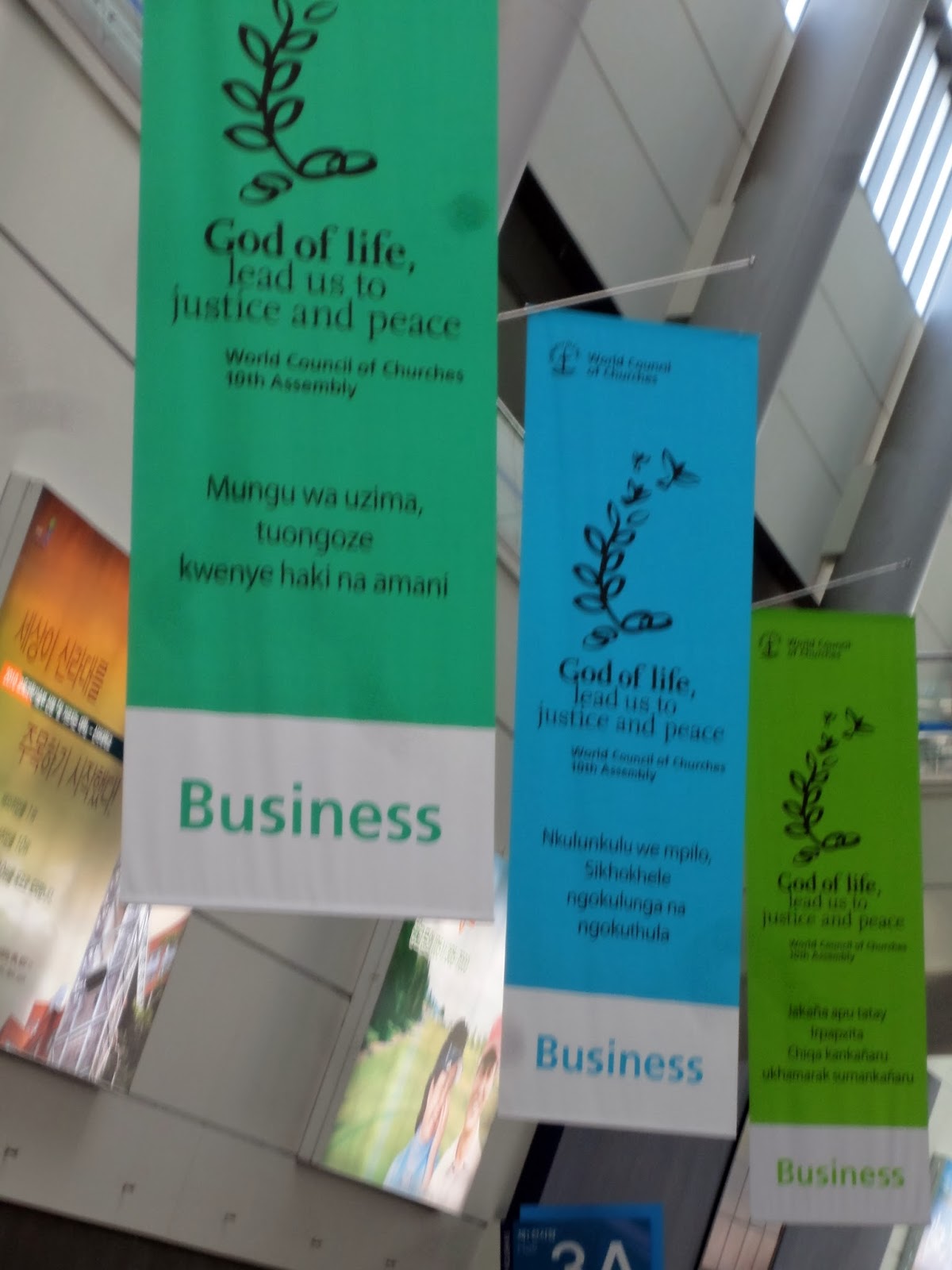
Banner of the Assembly
Catholic delegation at the opening


  The first Assembly took place in Amsterdam in 1948 just after the war.  This assembly is known as the ‘founding assembly’ since it was at this meeting when the WCC officially came into being.  Since then every seven years there is a coming together to do the work of the council   The last one was held in Porto Alegre in Brazil in 2006.
  The way the assembly works is that Council’s member churches sent delegates as their official representatives.  These would be the voting members of the assembly.  However, other invited delegates come as well and participate in the sessions but do not take part in the voting decisions that are held.

Cardinal Kurt Koch delivers Pope Francis' message


 Every assembly has three main functions:
  • the assembly is an occasion to celebrate and reaffirm the mutual commitment that member churches and ecumenical partners have made through the WCC.  It is a celebrative moment to reaffirm their confession of faith in Jesus Christ as Lord and to express the visible unity of the church.
  • it is the time to render an account of what has been done since the last assembly.  Many reports are given both in oral and written form to the delegates in the business plenary sessions.
  • since the assembly is the highest decision making body of the WCC, decisions and policies must be taken and made. In addition it needs to select 150 members of the central committee which assumes the responsibility for guiding the work of the Council for the next seven years.  These are elected from a slate of nominated persons from the churches.


The beginning
  Each assembly is different and Busan is no exception.  The gathering of so many people (5,000) and the re-connecting with old friends and the making of new lasting relationships is one of the joyful aspects of the Assembly. The colors and traditions of the Korean church added a lot to the opening ceremony.


  Since the theme of the assembly touches on the questions of peace and justice, the opening worship brought in the ideas of seeking forgiveness against nature and the against the rights of people.  At the beginning of the worship the Assembly asked for forgiveness in a dramatic way.


  In addition we experienced the history of the Protestant churches in Korea in the opening plenary session.  It was a spectacular of drama, music and history.


 Tomorrow the Assembly will go into full swing with a very full day.  The real work will begin tomorrow with the various committees starting their work.  By the way the meeting is being held in the very modern Conference Center in Busan.


Peace and all good.

Wednesday, October 30, 2013

Anglicanism and Orthodoxy in Korea

  Today is our last day in Seoul since we will head down to Busan for the Assembly this afternoon.  However, before  doing so we had two stops left: the Anglican Church and the Orthodox Church.

Anglicanism in Korea
  Anglicanism came to Korea in 1889 when Bishop Charles John Corfe was ordained and the first diocese of Joseon was founded.  As was the practice of many of the mission societies, the Anglican church established a number of educational institutions, medical facilities and social work in various centers throughout the country (both in the North as well as in the South).  The Anglican church sought ways for the church to be integrated into Korean culture.  For this reason many of the buildings may be found in the traditional Korean style such as the Bishop’s residence in Seoul.


  The first native Bishop, Lee Cheon Hwan, was ordained in1965 and only died in 2010. Three dioceses were established and social institutions continued to be opened.  The Anglican cathedral in Seoul is named Sts. Mary and Nicholas and was built in 1922 in the Romanesque style.  The actual community is not very large but is active with many projects.


  Cardinal Kurt Koch, President of the Pontifical Council for the Promotion of Christian Unity joined us in our last visits and will travel with us to the Assembly.

Card. Koch receives gift from Anglican Bishop Paul K. Kim


The Orthodox church in Korean
 Orthodoxy came to Korea via Russia in 1900.  For various political reasons such as the Sino Japanese war and the Bolsheviks revolution, caused great difficulties in continuing orthodoxy. The care of the church was transferred to the Archbishop of Tokyo. Then came the horrors of the Second World War and the Korean Orthodox church found itself cut off once again.  Finally in 1950, the Korean War followed.  This was


disastrous for the church since the only Korean priest was captures and never seen again.  It was under the care of the Archimandrite Andreas Halkiopoulas that the church found new live in the Ecumenical Patriarchy.  Even though it is not a large community is it once which cares for its people and is open ecumenically.


Card. Koch & Metropolitan Ambrosios of Korea


After a quick lunch in the train station we were off to Busan leaving at 2:15 PM and arriving at 4:58 PM.  Now its down to business with the opening of the 10th General Assembly.

Buddhism and ecumenism in Korea continued

Pilgrimage to the shrine of martyrs
The second part of our day was highlighted by a pilgrimage to the place of martyrdom, the Jeoldusan Martyrs’ Shrine.  There were several waves of persecutions of Catholics since the first in 1791. This was the site of the beheading of Catholics who were suspected of helping the French invade the Joseon coast in 1866.


This event sparked the fifth major persecution of Catholics and led to the execution of many. Why was this site chosen? It was on a high hill overlooking the transportation, trade, and business on the Han river between China, Japan and Western powers.  Since the Catholics were considered to be the culprits enabling the French invasion, only their blood could wash away the filth of the invasion.  This is why after beheading their heads were washed in the river.


Today this is the resting place for the relics of 27 of the martyrs who lost their lives defending their faith.  The most famous one was Andrew Kim Tae-gon, the first Korean priest who received the palm of martyrdom on September 16, 1846.  A very large bronze statute of St. Andrew Kim wearing traditional garb was erected on the site.


The Catholic delegation celebrated the Eucharist in the chapel after praying in the crypt that contains the relics of some of the martyrs.  May the blood of these witnesses of faith inspire all the delegates at the WCC Assembly to seek the unity of all those who believe in Christ and witness to him with lively faith and especially for the unity of this divided Korea.


Gyeongbokgung Royal Palace


Next we went to explore some more of Korean history and culture by visiting the Gyeongbokgung Palace (which translates: Palace Greatly Blessed by Heaven).  This Palace was built in 1695 three years after the founding of the Joseon dynasty. It was a beautiful autumn late afternoon with the sun beginning to set when we arrived at the site of the palace.


 At the apex of the Joseon dynasty this complex had over 500 buildings.  Most of these were destroyed during the Japanese invasion in 1592 since it was the symbolic location of the royal power, politics, economy and culture of the dynasty.  After the Japanese occupation, the palace was partially rebuilt and has been restored since 1990 to his past splendor.  It is an extremely beautiful complex especially with the fall colors and the play of the light of the setting sun on the buildings and reflection in the water.


We were fortunate to have a guided tour the complex which now consists of only 125 of the original buildings.


The last rays of the setting sun accompanied us to our last stop of our second day.


Representatives of the National Council of Churches
Rev. Kim Young-ju, General Secretary, met us and hosted another traditional Korean meal with its many dishes and surprises.  It was 130 years since Protestantism arrived in Korea.  The Korean National Christian Council was founded in 1924 which were the beginnings of the Council of Churches in Korea.


We learned that Protestantism established itself first by missionary work in the founding of women’s hospitals and schools for the education of girls.  Then came Bible schools. While the Catholic mission was orientated toward the establishment of the hierarchy and a sacramental structure, the Protestant Methodist and then Presbyterians began with the education of women and the establishment of schools.  Of course, this is not to say that Catholics didn’t do so as well but it was important to establish the faith in a new cultural setting.
The various mission societies decided that instead of competing for believers they divided the peninsula into mission territories, each being assigned a geographical area. This is how Protestants arrived mainly form the united Stated and Great Britain to evangelize the country.
  As I said earlier we had some new dishes to try before calling it a night.

Buon appetito!


It was a long day.  Tomorrow, our last in Seoul we will visit the Anglican and Orthodox churches and then make our way to Busan and the beginning of the Assembly.
Peace and all good!