Pages

Monday, November 4, 2013

Down to Business at the WCC Assembly

New Presidents elected
   After the weekend of rest, the General Assembly picks up the pace.   The first elections took place in the business session this afternoon.  These will be ex officio members of the Central Committee.

The eight new WCC Presidents are:

Africa:  Rev. Dr Mary Anne Plaatjies van Huffel, Uniting Reformed Church in Southern Africa
Asia: Rev. Prof. Dr Sang Chan, Presbyterian Church in the Republic of Korea
Europe: Archbishop Anders Wejryd, Church of Sweden
Latin America and Caribbean:  Rev. Gloria Nohemy Ulloa Alvarado, Presbyterian Church in Colombia
North America: Bishop Mark MacDonald, Anglican Church of Canada
Pacific: Rev. Dr Mele’ana Puloka, Free Wesleyan Church of Tonga
Eastern Orthodox:  H.B. John X Patriarch of the Greek Orthodox Church of Antioch and All the East
Oriental Orthodox: H.H. Karekin II, the Supreme Patriarch and Catholicos of All Armenians

Water the source of life -- it purifies and liberates

     Today's worship used the symbol of water to re-link us to our baptism.  In baptism the water symbol has two valences:  it is a sign of life but also that of destruction.  The Christian is born "of water and the Spirit" (John 3:5). However, we know the consequences of water unleashed: floods, tsunami, polution -- all elements of destruction and death.
     Today millions of people die because of the lack of safe drinking water, yet multinationals like Coca-cola or NestlĂ© buy up the water rights in the same countries were people do not have access to their own water. They profit from selling water while the legitimate owners of the water die.

 Religious leaders from Christian, Muslim, Hindu, Jewish and Buddhist faiths poured water into a common vessel.  In almost all religions and their sacred texts, water is a symbol of cleansing, justice, peace, and it is therefore profoundly relevant to the Assembly theme: God of life, lead us to justice and peace.


      The Scripture reading for the worship and Bible study came from Acts 8:27-39, the story of Philip and the Ethiopian eunuch. Not only did we consider the question of baptism but also that of mission since Philip was proclaiming and explaining the Word of God.  This led the eunuch to seek baptism.

We praise you God, for this font, for you breathe into the water to wash away sin and birth us anew into you peace and joy. We praise you, O God for water!
O God, you are the Ocean, the source of all life. 
  O God, you are the River, saving us from death. 
  O God, you are the Stream, restoring our community's strength. We praise you O God, Father, Son, and Holy Spirit, today, tomorrow, forever. Amen and Amen!


     The theme of water was then further developed in the Bible study as we made the transition from worship to the plenary on mission.

Mission: a call to life-giving witness
     You will remember that the plenary sessions serve to develop one of the major sub-themes of the Assembly.  Today it was mission.  The Commission on World Mission and Evangelism (CWME) presented its work on a Practical Guide that accompanies the WCC's updated statement on mission approved by the Central Committee in Greece in 2012 under the title Together towards Life:  Mission and Evangelism in Changing Landscapes.  
     Three presentations were made whose purpose was to focus attention on the new contexts within which mission and evangelism now take place.
     Fr. Stephen Bevans, a Divine Word missionary, painted a picture of the contexts of mission today.  In his dynamic presentation he underscored the role of the Spirit in mission and the implications it has for mission work in different contexts.


Rev. Cecilia Castillo NanjarĂ­, a Penecostal Pastor from Chile, spoke on "New Ways of doing Evangelism" in the contemporary context of the world.  She emphasized the fact that the churches are responsible for paying little or no attention to the major problems of women and indigenous populations at risk. She addressed new concrete ways of witnessing to the Gospel of Life in secular, post-modern contexts.

Bishop Dr. Geevarghese Mor Corillos, who is moderator of the CWME, speaking on the concepts of mission, including “mission from the margins”, derived from the new affirmations of the mission statement.  In his presentation he made mention of the Bishop of Rome, Pope Francis who has set an example by calling for a church of the poor who minister to the poor.  This is the great challenge today for any kind of missionary work. He presented four points that he felt are essential for revitalizing mission today.  First it must be Trinitarian orientated, namely reflecting the inter-relationships of the Divine Trinity of love and respect for all of creation.  Secondo, it must be Spirit inspired and Spirit driven that will compel all toward the God of Creation.  Third it must be respectful of the contexts of the people and finally it must be mission to the margins.  Only in this way will missionary activities bear lasting fruit.


Baptism document: front and center!

One of the Madang Worshops today was the presentation of the recently published Faith and Order Commission text One Baptism:  Towards Mutual Recognition.


Following the BEM report of 1982, the Faith and Order Commission continued the study on baptism. When the Churches responded to BEM a number of questions came to the surface.  One question in particukar was concerning the mutual recognition of baptism and what this means practically for the churches.  The text picks up where BEM left off. One of the rich results from this 10 year study was the fact that the churches talk about baptism as part of a wider process of conversion which is life long. Questions about the mutual recognition of baptism and ecclesial recognition are considered in this text as well as the consequences of putting mutual recognition fully into practice.  A lively discussion  pursued after brief introductory remarks by some of the people who worked on the text or have been involved in Faith and Order projects.


Ecumenical conversations

The conversations continued.  I have been following the ecclesiological statement conversation.


We continued exploring the implications of this statement.  This time with input from two women: one from China and the other from Latin America.  Their perspectives were based on how their churches might receive this text.  One was a pastor in a Pentecostal church and the other in a "post-denominational" church. Difficulty was expressed in having access to some of the language of the text since it was not the type of vocabulary that their churches were used to. However, they found the text beneficial in allowing them to pose questions to their own churches. Both spoke about the new realities of non-denominational or new charismatic churches that are being born and the issues that these will pose to the understanding and discussion of the text.

Ms Cecelia Castillo Nanjari and Rev. Manhong Lin

Always new discoveries in Korean cuisine

    The Catholic delegation has been eating in one of the restaurants in the convention center.  Its name is Party & Play.  Almost every night there is something new or curious to be discovered and tried.  Tonight it was a new fruit that we discovered.  It is soft and sweet on the inside.  I understand it grows pretty much in the Philippines.  
Here is what it looks like:

Mangosteen fruit


Here is the reaction to a first encounter:


So from me to you:


Peace and all good!

Sunday, November 3, 2013

Eucharist in the Busan Cathedral

A day of rest and praise

The Catholic delegation joined with the local church at the Cathedral of St. Kim for the celebration of the Sunday Eucharist.  I saw some other delegates from the WCC present including the wife of the Secretary General, Mrs Tveit.


Two of the stewarts at the Assembly
The cathedral is very modern and beautiful in its simplicity.  A lot of natural light streaming in through beautiful stained glass floods the body of the church with a warmth and welcoming atmosphere.


  The doors to the cathedral has an etched scene of the mountains with Christ the Good Shepherd and his sheep.


The interior is made of simple stone and the wood furnishings add a warmth to the worship space.  Just as in Seoul, the Cathedral was packed and the people were  very active in their participation.  The Cathedral choir led the congregation in hymns and the liturgical parts of the mass.


Archbishop Kim presided with the Bishop members of the delegation while the presbyters concelebrated.
In his Archbishop Kim’s homily, he said that “the ecumenical movement is not a choice, but a supreme order of our Lord to be carried out”.  In addition it is not a matter of human intimacy between Protestants and Catholics but rather a faithfulness to the teaching of the Gospel and to the Spirit in concrete action together.


Following the service all the delegates from WCC who attended were invited to a lunch offered by Archbishop Paul who was unable to be with us because of confirmation. The President of the parish council was present to greet us as well as the pastor of the cathedral parish, Fr. Lee.

Fr. Lee, Pastor of the Cathedral

The rest of the afternoon was quiet.


In the evening we were invited to join the Benedictine sisters for sung vespers in their chapel. The day ended with a simple evening meal prepared by the sisters.  So the day was restful as we recuperated our forces for Monday’s work at the Assembly.


Peace and all good!

Pilgrimage with Korean Churches

A pilgrim prayer
Today the Assembly encounters the local churches in Korea and makes pilgrimage to the DMZ to pray for peace, reconciliation and unity for Korea.  The participants remembered all those countries who are divided and suffer civil war and the countless victims of violence.  We were sent forth with the words: Let justice spring forth from our earth, and let the fruits of love flourish.
From my previous blogs you all know that the Catholic delegation spent the week before the Assembly encountering the various churches in Seoul so we had the opportunity to do some historical and cultural tourism.
         It has become a group joke that we are always ready to line up for a group picture.  But here is one that we all sat for!
As we journeyed from Busan out into the countryside we saw the rice fields harvested or being readied for harvesting.  Since rice is a principal element of the Korean diet we saw fields and fields of rice paddies.


        It was a warm and sunny day not at all like one would expect in November.  We were very fortunate since the colors of the changing leaves were reaching their peak and the various places that we visited today were a real spectacle of color and harmony.  


We were on our way from the Benedictine Sisters’ retreat house where we are staying to the ancient site of the Silla dynasty in Gyeongju.

Benedictine Sisters' Retreat House


At the National Museum we were greeted by the mayor of the city according to traditional customs with flowers and gifts.  This was the ancient capital of Silla where the museum has been moved since its opening in 1945.  It is one of the largest and most prestigious museums in Korea.  Since it was a weekend there were lots of Korean tourist.  I think sometimes we were objects of their curiosity!


In this region are located some of Korea’s major historical attractions and we will visit them today.  These include the archeological museum and the art hall, Daereungwon Park, Donnunge (Eastern Palace) and Wolji (Moon Pond) as well as Bulguksa Temple.  So let’s begin.


Gyeongju National Museum
Upon entering the Museum park we perceived at a distance the Divine Bell of King Seongdeok.  The bell is the largest and second oldest in Korea completed in 771.  Its purpose is to wake all of creation to attentive prayer.  Unlike Western bells this bell has no clapper.  It is rung by hitting the bell with a large wooden or metal rod.  The tones of the bell last for 24 seconds with its vibrations emanating outward to call all souls to pray and to relieve the souls that are suffering pain.  Even though its last range cannot be heard the sound wave continues deep into creation.


The bell contains descending angels on it as well as inscriptions in Chinese explaining that this bell was completed after its first failed attempt by the son of the King.  Decorations have lotus blossoms as well as the angels on its sides.


Lotus blossom on sleeve of tradition dress

Next was the three story stone pagoda from the Goseonsa Temple site.  The pagoda is believed to be the place where the ashes of Buddha are kept and so they find a central place in the temple presincts.  The animals on the edge protect it from anyone approaching this sacred spot.


Inside the museum there were many statutes of Buddha and lesser gods and goddesses. Three remarkable ancient golden crowns were discovered in the ruins of the site of the palace.  In fact many of the artifacts were preserved in a wooden coffin because they were in the mud under the drained pond.  Almost all of the items in the museum are from the Silla dynasty period.


Donggun and Wolji in Gyeongju
From the National Museum we traveled a short distance to the Eastern Palace and Moon Pond.  Again we were greeted by wonderful colors on the trees.


 The whole site was a beautiful harmonious setting for the royal palace and surroundings. These buildings come from the unified Silla period and included the palace and adjoining buildings attached to the palace and a garden.  In 674, Silla King Munmu constructed a lake as well as an artificial hill to grow rare flowers.  It is here that the last King of the Silla dynasty, Gyeongsunwang, hosted a festive banquet for Goryeo Taejo, the founder of the Goryeo dynasty.  Its natural beautiful setting must have been something in the golden period of the Silla dynasty.


And yes we took a group picture!


Cheomseongdae Observatory in Gyeongju

Ancient tombs with mountain in the background
Another short ride took us to the archeological park and forest in Gyeonhju.  This was a central part of the Silla capital and contains numerous historical sites.  Besides the tomb of King Naemul (356-402, the 17th ruler of the Silla Kingdom) we found perfectly preserved ancient tombs.  From reconstructions we can see traditional homes and features of ancient Silla. King Naemul was famous for tricking Japanese pirates with scarecrows on the slope of Mt. Toham (seen in the distance).  He fended off several invasion attempts by the Japanese and promoted trade with China.


In the center of the site we saw the Cheomseongdae Observatory that was build in the reign of Queen Seondeok (632-347) and is the oldest astronomical observatory in East Asia.   Obviously there were no telescopes at this time but people ascended to the top and from a dark interior gazed at the constellations in the night sky.  Its form is also uniquely made of stone that gives a sense of balance, harmonizing straight lines with curves.


Surrounding the site is the Gyerim Forest, once again dressed in beautiful autumn colors.  Located at the edge of the forest are some traditional houses and crossing the river is a wooden bridge that is being reconstructed.


It is here that we had a very traditional meal.  You can see the elegant place setting with many small dishes.


These were only the starters or “antipasto”.  


It seemed that the food would never end so you have to be careful about not taking too much in the beginning.  Yes, that’s right, we were all seated on the floor in a lotus position (if you care to believe that!).  Some of us had a little help with small seats that allowed us to stretch our legs out under the table since the old knees wouldn’t take the stress.

In any event we made it through this wonderful meal.  We even had rice wine.  The meal was served by women in traditional garb.

 It went from small salads of vegetables or sea food, to a type of omelette, raw fish, fried fish, some beef and sweet and sour pork, cow’s tail, seaweed, lotus roots, several seafood soups, Korean pear, ginger, and lots of hot spices.  A wonderful array of flavors.  Oh, yes I forgot a bowl of rice!


  After a leisurely walk back to our bus we were off to our next site.


Korean children enjoying a Saturday visit to the country side


Bulguksa Temple
To enter a Buddhist sacred area you pass through three gates: the open gate, the protector’s gate and the gate to paradise. The Bulguska Temple is harmoniously situated, like all temples, in a natural setting of beauty.  We lucked out again with the fall colors of yellows, oranges and reds mixed with the evergreen of pines.


At the second gate we met the four guardians who protect the temple, north, south, east and west. They are fearsome looking characters to ward off anyone with evil intentions.


As we approached the main hall we found that there are several ways to ascend.  The central set of stairs (called bridges) known as the blue cloud bridge (Chengungyo) and the white cloud bridge (Baekungyo) are intended for royalty to ascend to paradise where Buddha resides.  The rest of us have the arduous way of climbing the long way around to approach the central chamber where Buddha resides and paradise is to be found.  These are all metaphors for how each one ascends through meditation and disciple to the paradise of Buddha.  By the way, our guide let us take the short cut!


Entering by the back door we see the view of Dabotap with the Seokgatap Pagoda.  Immediately on the left were the instruments used to call to worship, the large fish, the dragons, the drum and cymbal.  The intricate designs and colors are typical of all Buddhist temples.


The temple itself is very elaborate and beautiful on the outside.  No pictures were allowed of the main hall of the temple.  However, I did manage to take one of a smaller temple next to the main one where pictures were permitted.  This is the Daewongiun seated golden bronze Vairocana Buddha.  We were told that even though some Buddha statues appear to be feminine there is no sex to Buddha.


The Daewongiun which contained the sitting Buddha had some particulars that were pointed out to us.  There was a golden pig constructed immediately behind the writing over the main entrance to the hall.  This pig was latter constructed out of gold and placed in the courtyard so that worshipers could touch it and have good luck.  Even I group had a go at it.  Now we will see if their wish comes true.


Also on the side of the temple hall a swastika was pointed out.  This was an ancient religious symbol for the sun and did not have later connotations.


As we begin our exit from the temple, we passed by Banyayeonji or the pond of wisdom with the hope that our wisdom increased because of our cultural pilgrimage.


Taking one last look around as we left, we admired God's creation in all of its colors.


Modern Busan
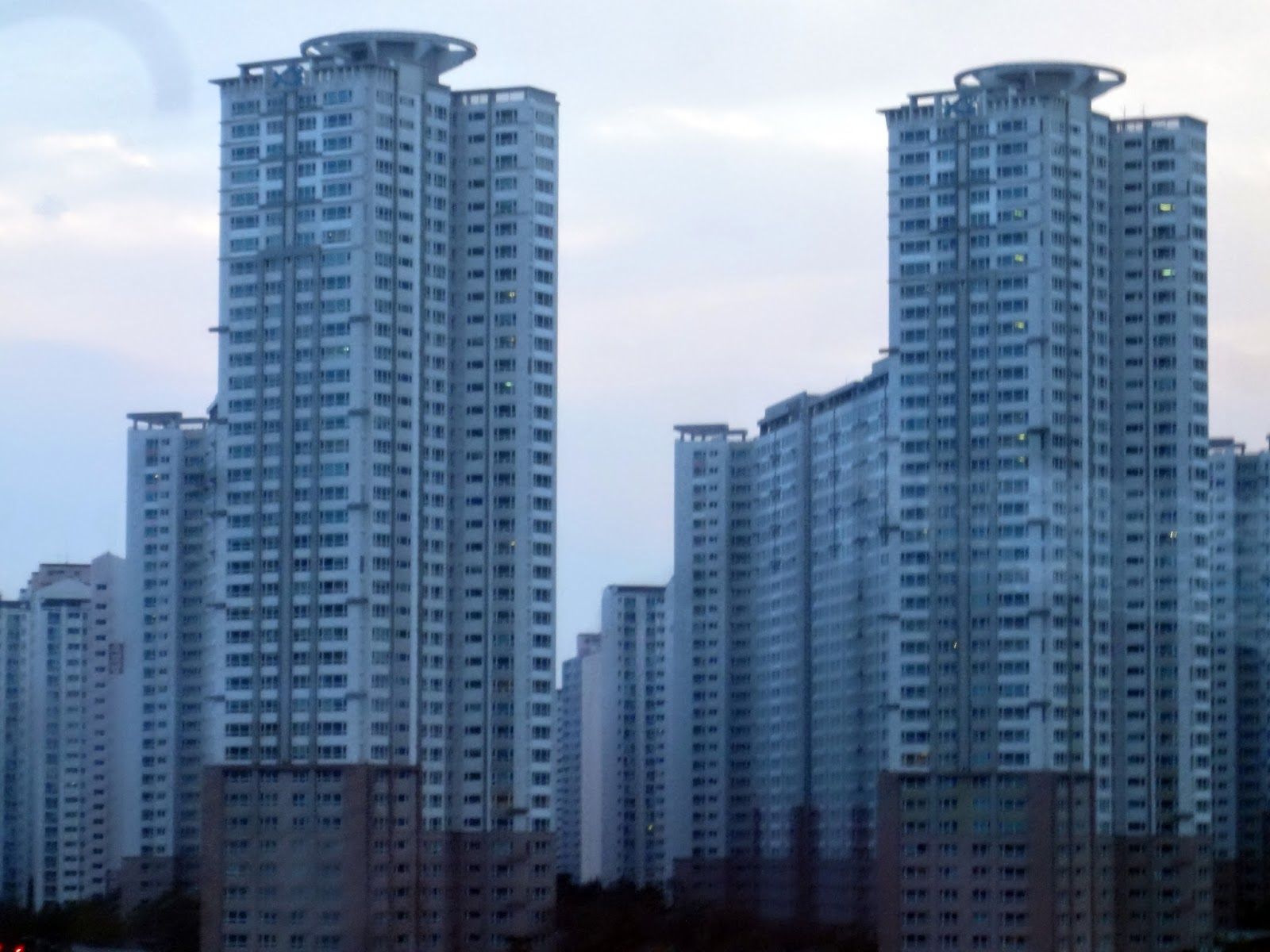
Returning to the retreat house we had glimpses of modern Busan.  It is amazing how the second city in Korea with its 15 million inhabitants live in these super modern but small apartmenst.


  You can see how tall they are and how many of them are spread throughout the city area.  Where once the simple had longed to move into one of these modern lodgings now they desire to return to more traditional homes with a little land for a garden and their own space.


Well that was our enriching day of cultural tourism.  Tomorrow we are off to the cathedral of Busan to celebrate the Eucharist and meet some of the local people.  I am sure we will have another traditional meal hosted by Archbishop Kim.


 Peace and all good!